
You spent hours trying to cram your work experience onto a single page.
Shrinking the font to 10 pt. Cutting out achievements you're proud of. Wrestling with margins and line spacing just to make everything fit.
All because hiring managers want one-page resumes… but do they?
We surveyed over 200 HR professionals to find out what the truth is, and the results might surprise you.
In this article, we'll show you:
- What the Data Says
- When to Use a One-Page Resume
- How to Perfect a Two-Page Resume
…and more!
Let's get started.
Want to make sure your resume impresses the hiring manager? Use our professional resume builder to create your resume in minutes!
Choose a resume template to get started.
How Long Should Your Resume Be?
While a one-page resume has been the norm for nearly a decade, two-page resumes are on the rise.
We surveyed over 200 HR professionals to find out what they actually prefer when it comes to resumes. The results were clear: 68.3% of hiring managers consider a two-page resume ideal, while only 21.8% actually prefer a one-page format.
This is a major shift from traditional advice. For years, career coaches insisted that resumes have to fit on one page, no exceptions. But the data tells a different story.
Here's the full breakdown:
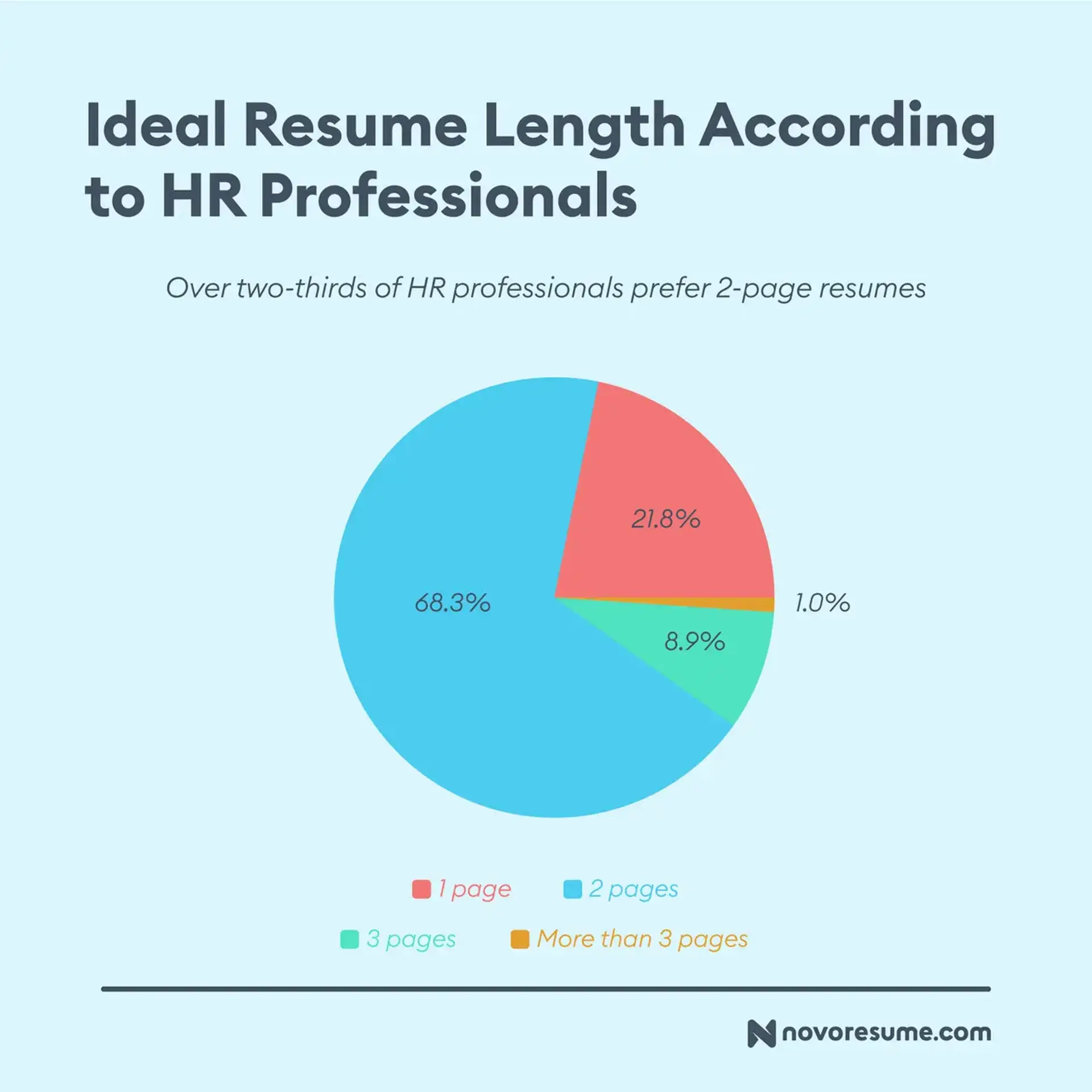
- Two pages: 68.3%
- One page: 21.8%
- Three or more pages: 9.9%
But here’s an important detail. When we asked hiring managers whether they'd consider resumes longer than 2 pages, over 92% said yes – as long as the candidate looks relevant at a glance.
And it’s not just our research either. According to a 2024 academic study on resume parsing, professional resumes include an average of 88 to 102 distinct pieces of information called “segments.” These are individual data points like your job titles, company names, employment dates, specific skills, educational credentials, and quantified achievements.
Each segment helps hiring managers and applicant tracking systems understand your qualifications. If you have 5-10 years of experience with multiple roles, certifications, and accomplishments, your segments add up quickly, and fitting those details onto a single page is nearly impossible.
So, if you've been cramming all your experience onto one page, you're likely doing yourself a disservice. A two-page resume gives you room to showcase all your relevant achievements, provide context for your career progression, and include the details that actually matter to hiring managers.
That said, resume length isn't one-size-fits-all. Your experience level, industry, and the specific role you're applying for all factor into the decision.
Why Do Hiring Managers Prefer Two-Page Resumes?
Hiring managers need to make informed decisions, but doing so with only the bare minimum information about a candidate is challenging.
A two-page resume gives you space to showcase your achievements without sacrificing readability. Instead of cramming bullet points into tiny fonts or cutting out essential details, you can present your work history in a way that's both comprehensive and easy to scan.
Hiring managers don't want a laundry list of responsibilities, though. They still want to see your impact, and with two pages, you can include quantifiable results, specific projects, and the context that makes your experience meaningful.
Your career progression can also tell a story, as long as you give it the room to breathe. A two-page resume lets you demonstrate career growth, show how your skills have evolved, and connect the dots between different roles you’ve had so far. The hiring manager will see how you’re on a path that matches the role you’re applying for with their company.
If you’re a mid-level professional with 5-10 years of experience, this is especially important. Your early roles might still be relevant, but you need to put them into context. Two pages let you do that without overwhelming the reader.
And on top of that, if you try to fit everything on one page, your formatting just won’t look good. Text gets cramped, margins shrink, and the overall design becomes an eyesore.
A two-page resume allows for neat spacing, clear section headers, and a professional appearance that actually helps hiring managers find what they need in under a minute.
When Should You Use a One-Page Resume?
Despite the data showing a preference for two-page resumes, there are still situations where a one-page resume makes more sense.
If you're fresh out of college or have less than 3-5 years of work experience, a one-page resume is usually your best bet. You simply don't have enough relevant experience to justify a second page, and trying to fill one with fluff will work against you.
Hiring managers expect entry-level resumes to be concise. Focus on your education, internships, relevant coursework, and any projects or volunteer work that demonstrate your skills. Quality always beats quantity, especially when you're just starting out.
If you're switching to a completely different field, a one-page resume should also help you stay focused on your transferable skills rather than dwelling on irrelevant work experience. The less related your previous experience is to the role you're applying for, the more selective you need to be about what you include.
Finally, the employer might explicitly ask for a one-page resume in their job posting. If that's the case, follow their instructions. It might be a test to see if you can follow directions, or they might have a specific screening process that works better with shorter resumes.
Some industries in particular appreciate brevity. If you're applying to startups, creative agencies, or roles where concise communication is valued, a one-page resume might still be more appropriate.
5 Common Mistakes with Resume Length
Regardless of what the right length for your resume is, how you deal with it matters. Here are the most common resume mistakes when it comes to resume length:
- Cramming everything onto one page. Shrinking your font to 9 pt, cutting the margins to nothing, and eliminating all the white space make your resume unreadable. If hiring managers have to squint to read your achievements, they won't bother. Use the space you need to present your work experience clearly.
- Adding fluff to reach two pages. Don't pad your resume with irrelevant details, outdated skills, or buzzwords just to fill space. If you only have one page of strong content, that's better than a weak two-page resume.
- Going beyond two pages. Unless you're in academia, research, or a senior executive role, three or more pages is excessive. Most hiring managers won't read past page two, so anything beyond that is wasted effort.
- Burying your best content. Your resume has under six seconds to make a good first impression. If your strongest qualifications are buried on page two, they might never see them, so front-load them on page one.
- Inconsistent formatting. If you're using a two-page resume, make sure both pages follow the same design, font style, size, and spacing. Inconsistencies look sloppy and unprofessional, and they break the flow for anyone reviewing your application.
Conclusion
The one-page resume is on its way out, and the data proves it. Over 68% of hiring managers prefer two-page resumes, so you don’t need to cram your experience just to fit that page limit.
For most professionals with more than a few years of experience, two pages provide enough space to highlight achievements and career growth. Entry-level candidates can still stick with one page, but if you have substantial experience to showcase, don’t be afraid to expand on it.
Just use your space wisely. Focus on relevant achievements and clear formatting that makes it easy for hiring managers to see your value at a glance.